
You overdrew your account by $47.
It was an honest mistake. You forgot about that autopay. It happens.
But instead of thinking “Oops, I’ll fix that,” you think: “I’m terrible with money. I always do this. What’s wrong with me?”
Welcome to financial shame.
And if you’ve ever spiraled from a simple money mistake into questioning your worth as a human being, you’re not alone. Financial shame hits women differently than other types of failure. Mess up at work? You’re having a bad day. Burn dinner? You laugh it off.
But mess up with money? You’re irresponsible. Undisciplined. Foolish. A failure.
Here’s what you need to know: That credit card debt doesn’t make you a bad person. But financial shame makes it feel like it does.
What Is Financial Shame?
Financial shame is the belief that your money mistakes reveal something fundamentally flawed about who you are as a person.
It’s not just feeling bad about a financial decision. It’s feeling bad about yourself because of that decision.
Financial shame sounds like:
“I should know better by now”
“Everyone else has this figured out except me”
“I’m so stupid with money”
“I’ll never get ahead”
“What’s wrong with me?”
Notice the shift? It moves from the behavior to your identity.
You didn’t make a mistake. You are a mistake.
And that’s where financial shame becomes dangerous. Because when shame attaches to identity, it stops you from taking action. You can’t fix something if looking at it confirms you’re broken.
Why Financial Mistakes Feel Like Moral Failures
Money carries moral weight in our culture in ways other things don’t.
We use language that conflates finances with character:
- Good debt vs. bad debt
- Responsible vs. irresponsible spending
- Living within your means (implying those who don’t are morally deficient)
- Financial discipline (as if money management is about virtue)
Nobody calls you morally deficient for being bad at math. But being bad with money? That’s a character flaw. Yikes!
This is especially true for women. Research shows women experience financial shame at significantly higher rates than men—even when making the same money mistakes.
Why? Because women are held to impossible standards:
- Be financially independent (but not too aggressive)
- Provide for your family (but don’t be materialistic)
- Save for the future (but don’t be stingy)
- Earn good money (but don’t be obsessed with wealth)
You can’t win. So when you fall short, financial shame floods in to fill the gap.
The Shame Spiral: How It Works
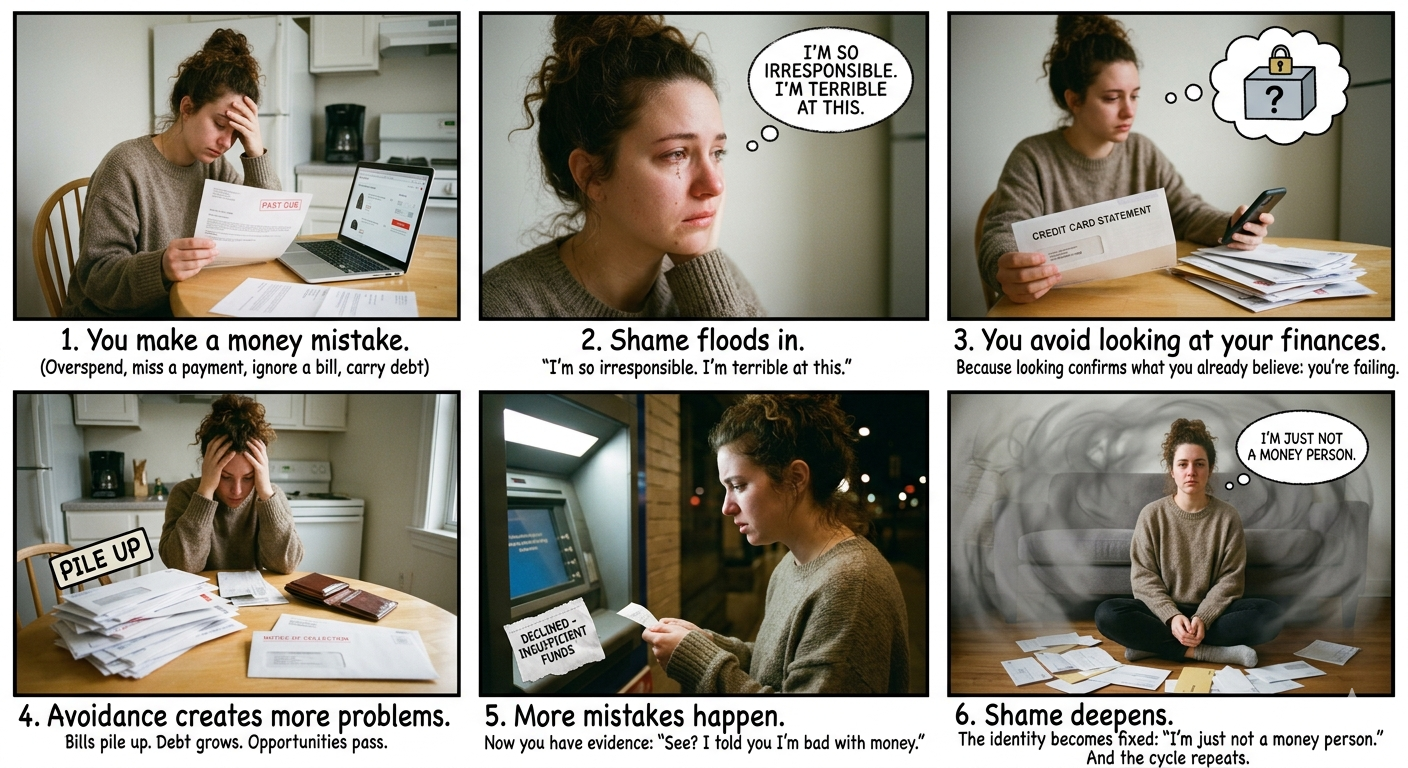
Financial shame doesn’t just make you feel bad. It creates a cycle that keeps you stuck.
The Shame Spiral: How It Works
1. You make a money mistake
(Overspend, miss a payment, ignore a bill, carry debt)
2. Shame floods in
“I’m so irresponsible. I’m terrible at this.”
3. You avoid looking at your finances
Because looking confirms what you already believe: you’re failing
4. Avoidance creates more problems
Bills pile up. Debt grows. Opportunities pass.
5. More mistakes happen
Now you have evidence: “See? I told you I’m bad with money.”
6. Shame deepens
The identity becomes fixed: “I’m just not a money person.”
And the cycle repeats.
This is the financial shame spiral. And it’s incredibly hard to escape because shame thrives in hiding.
The very thing that would help you (getting clear on your numbers) is the thing financial shame won’t let you do.
Signs You’re Stuck in Financial Shame
See if any of these resonate:
✓ You feel a pit in your stomach when money comes up
✓ You compare your financial life to others and feel inadequate
✓ You avoid financial conversations, even with safe people
✓ You lie or minimize when asked about your finances
✓ You punish yourself for money mistakes (“I don’t deserve nice things”)
✓ You replay past financial decisions with harsh self-judgment
✓ You believe you’re uniquely bad with money
That’s financial shame talking. And it’s lying to you.
Why Financial Shame Is a Liar
Let me be very clear about something: Financial shame operates on false premises.
Shame says: “You’re bad with money.”
Truth: You were never taught. Schools don’t teach personal finance. Your parents probably didn’t either. You’re learning as you go—like everyone else.
Shame says: “You should know better by now.”
Truth: Learning happens through experience, including mistakes. You can’t “should” yourself into knowledge you were never given.
Shame says: “Everyone else has it together.”
Truth: 80% of Americans are in debt. 70% live paycheck to paycheck. Most people are winging it and hoping for the best.
Shame says: “This debt defines you.”
Truth: Debt is a financial tool that got misused. It’s solvable. It doesn’t determine your worth, intelligence, or future.
Financial shame thrives on isolation and secrecy. It wants you to believe you’re uniquely flawed.
You’re not.
You’re a woman navigating a financial system you were never taught, often without support, doing the best you can with what you know.
That’s not failure. That’s courage.
How to Break the Financial Shame Spiral
You don’t break financial shame with force. You break it with truth and compassion.
Here’s where to start:
1. Name the Shame
When you feel that familiar pit in your stomach, say it out loud:
“This is financial shame. It’s not truth.”
Naming it separates the feeling from your identity. You’re not the shame. You’re experiencing shame. Big difference.
2. Separate Behavior From Identity
Write this down:
“I made a money mistake. That doesn’t make me a mistake.”
Your behavior is changeable. Your worth is not.
Financial shame wants you to believe you are your bank balance. You’re not.
3. Tell Someone Safe
Financial shame loses power when exposed to light.
Tell one safe person—a trusted friend, therapist, financial coach—one thing you’ve been hiding.
Not for advice. Just for witness.
“I’ve been avoiding my credit card statement for three months.”
Watch how shame shrinks when met with compassion instead of judgment.
4. Practice Radical Honesty (With Yourself First)
Open one account. Look at one number. Write it down.
Don’t judge it. Don’t fix it. Just see it.
“My checking account balance is $487.”
“My credit card balance is $6,200.”
Facts are neutral. Financial shame makes them mean something about you. They don’t.
5. Reframe the Story
Instead of: “I’m so bad with money. I always mess this up.”
Try: “I’m learning how to manage money. I’ve made mistakes, and I’m figuring out what works.”
Same facts. Different story. And the story you tell yourself matters.
You Are Not Your Bank Account
Here’s what I need you to hear:
Your credit score doesn’t measure your character.
Your debt doesn’t determine your worth.
Your bank balance doesn’t define your future.
Financial shame wants you to believe otherwise. It wants you to stay small, stuck, and silent.
But you don’t have to.
You can make money mistakes and still be a good person.
You can have debt and still be worthy of respect.
You can be learning how money works at 50 and still be intelligent.
This is not about moral failure. It’s about missing education, old patterns, and a nervous system protecting you from pain.
And all of that? Changeable.
Moving From Shame to Clarity
Financial shame keeps you frozen. Clarity sets you free.
When you can look at your numbers without attaching them to your identity, everything shifts.
You move from: “I’m a failure” to “I have $6,200 in debt to address.”
One is paralyzing. The other is a problem you can solve.
That’s the difference between shame and information.
Information is neutral. Information is workable. Information doesn’t judge.
Financial shame judges. And judgment keeps you stuck.
This week, practice this:
Notice when financial shame shows up.
Name it: “That’s shame talking.”
Breathe.
You are safe right now, even with this feeling.
Choose one small act of financial honesty.
Check one balance. Open one statement. Write down one number.
Remind yourself of the truth:
“My worth is not up for negotiation.”
A Gentle Invitation
If you’re ready to move from financial shame to financial clarity—to build a foundation that doesn’t crumble under judgment—I created something for you.
The 6 Steps to Flourish guide gives you a simple, shame-free framework for organizing your finances and rebuilding confidence.
No judgment. No pressure. Just clear steps that honor where you are while moving you forward.
Download the 6 Steps to Flourish → Here
Because you deserve to manage your money without carrying the weight of financial shame.
And you absolutely can.