
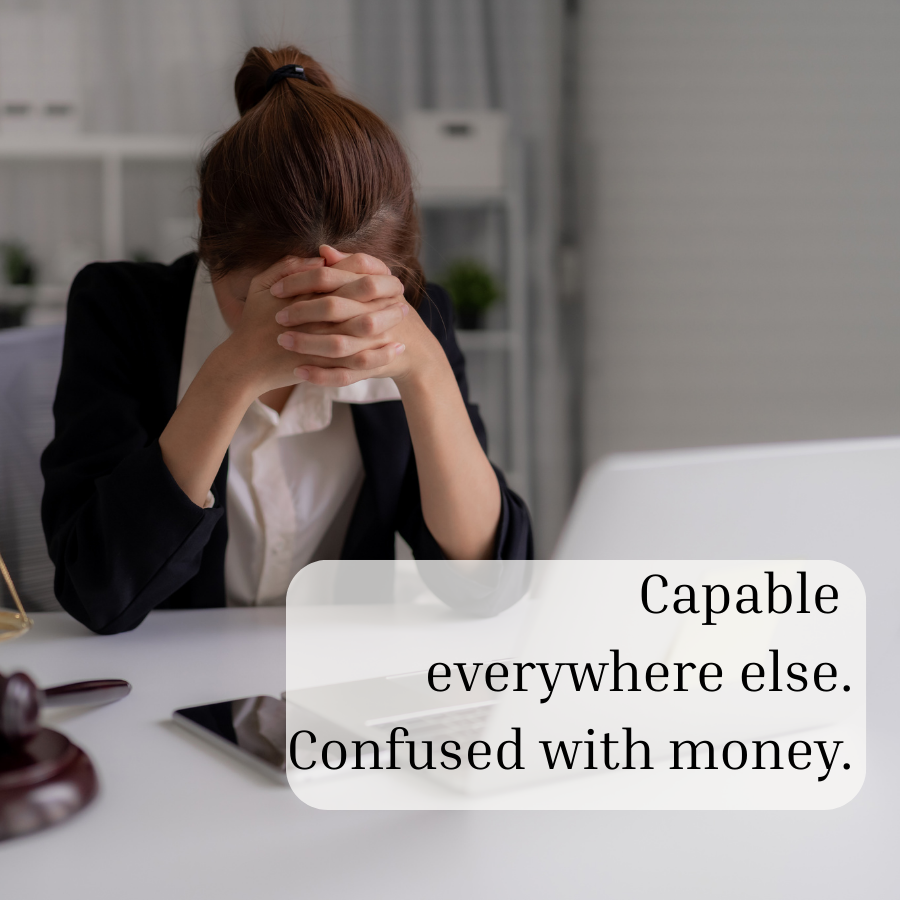
Perhaps you manage a team at work. You raised kids. Likely, you’ve handled crises that would break other people. You show up. And you figure things out. You are the strong tower for your family. The the person everyone else calls when they need help.
But when it comes to your own money?
You feel lost.
Not because you’re incapable. Not because you’re irresponsible. Not because you don’t care.
You feel overwhelmed by money because nobody ever taught you how to see the whole picture. And now you’re carrying the weight of financial decisions you’re not entirely sure how to make.
You have accounts you don’t check. Bills on autopay you’ve never reviewed. Debt you’re not sure how to prioritize. Savings goals you haven’t defined. Retirement numbers that terrify you.
And underneath it all, a quiet voice that whispers: “You should know how to do this by now.”
Here’s what I need you to hear:
You are not broken. The system is.
Smart women feel overwhelmed by money not because they’re bad with money, but because they’ve been handed a thousand pieces of conflicting advice, shame-based messaging, and unrealistic expectations without ever being given a clear map.
You don’t need more information. You don’t need to be smarter. You don’t need another app or another guru telling you what you should have done ten years ago.
You need clarity. You need structure. You need ownership.
And that’s exactly what we’re going to talk about.
No shame. No judgment. Just real answers about why smart women feel overwhelmed by money and what actually fixes it.
Table of Contents
- Smart Women Are Not Bad with Money
- Why Financial Overwhelm Is So Common
- The Hidden Cost of “I’ll Deal with It Later”
- What Actually Fixes Financial Overwhelm
- What “Ownership” Really Means
- The First Simple Step Toward Clarity
- From Overwhelm to Ownership
- FAQ: Smart Women and Money Overwhelm
Ready to stop feeling overwhelmed by money?
Download “Where’s My Money?” and get complete clarity on where you stand financially. Simple system. Clear picture. No shame.
Get “Where’s My Money?” for only $17
Smart Women Are Not Bad with Money
Let me tell you about Jennifer. She’s a nurse practitioner. She manages patient care plans, medication protocols, and life-or-death decisions daily. Can you imagine – life-or-death decisions daily! Not only that, she coordinates schedules for a team of twelve. She handles complex medical charts without blinking. And she raised two kids – mostly on her own.
But her own finances?
Complete chaos. “Who has time?” she asks.
Three checking accounts she’s not entirely sure why she opened. Credit cards she pays the minimum on but hasn’t looked at the statements in months. A 401k she contributes to but has never reviewed. Student loans that have been in repayment for twenty years. An emergency fund that never seems to grow.
When she came to me, she said: “I feel so stupid. I can manage million-dollar budgets at work. Why can’t I manage my own money?”
Here’s the truth Jennifer needed to hear, and maybe you do too:
Intelligence has nothing to do with financial clarity.
Being smart doesn’t automatically mean you understand money. Being capable doesn’t mean you were taught how money actually works. Being successful doesn’t mean you know how to organize your financial life in a way that makes sense.
Why Being “Good at Everything” Makes Money Harder
Women who are high-performers everywhere else often struggle the most with their own finances.
Why?
Because you’re used to being competent. You’re used to figuring things out. You’re used to already knowing the answer before you ask the question.
So when you don’t immediately understand how to prioritize debt payoff, or you’re confused about retirement accounts, or you’re not sure what to do with your savings, you feel ashamed.
And shame keeps you from asking for help.
The Emotional Load Women Carry
Here’s what most financial advice misses:
Women aren’t just managing money. They’re managing a million other things:
- Their own financial stability
- Often their children’s needs
- Sometimes their aging parents’ care
- The emotional weight of being “the responsible one”
- The fear of making a mistake that could hurt their family
- The pressure to “have it all figured out”
You’re not overwhelmed because you’re bad with money.
You’re overwhelmed because you’re carrying financial responsibility for multiple people while simultaneously judging yourself for not doing it perfectly.
How Shame Prevents Help-Seeking
The same shame that makes you feel “stupid” about money is the exact thing preventing you from getting the clarity you need.
You don’t ask questions because you think you should already know.
You don’t hire help because you think that’s admitting failure. Or maybe you think it’s only for “rich people.”
You don’t talk to friends about it because everyone else seems fine. Really fine. White picket fence and all.
So you stay stuck. Overwhelmed. Avoiding. Hoping it somehow fixes itself.
But avoidance doesn’t create clarity. Structure does.
Why Financial Overwhelm Is So Common
If you feel overwhelmed by money, you’re not alone. You’re actually in the majority. Hopefully that makes you feel less alone.
A 2023 study found that 65% of professional women report feeling stressed about their finances, even when they’re earning good incomes. It’s not about how much you make. It’s about how scattered the information is.
Too Many Tools, Opinions, and Accounts
Think about everything you’re supposed to manage:
Accounts:
- Multiple checking accounts
- Savings accounts (emergency, vacation, kids, future goals)
- Credit cards (rewards, balance transfers, store cards)
- Retirement accounts (401k, IRA, Roth, old employer plans)
- Investment accounts
- HSA/FSA
- College savings (529 plans)
- Maybe a business account
Tools:
- Budgeting apps
- Bill pay systems
- Investment platforms
- Credit monitoring
- Spreadsheets
- Paper files
- Password managers
Advice:
- What Dave Ramsey says
- What Suze Orman says
- What the Instagram financial influencer says
- What your coworker does
- What your mom did
- What the financial advisor recommended
- What you read in that book three years ago
No wonder you feel overwhelmed. It’s too much.
Information Overload vs. Understanding
You don’t have a lack of information. You have too much information without a framework to organize it.
You’ve read the articles. You’ve listened to the podcasts. You’ve saved the Instagram posts.
But none of it connects into a system that makes sense for YOUR specific situation.
Generic advice doesn’t account for:
- Your actual income and expenses
- Your debt structure
- Your goals and timeline
- Your values and priorities
- Your life circumstances
So you keep searching for the “right” answer, getting more overwhelmed with each new piece of advice that contradicts the last one.
Never Taught How Money Actually Works
Here’s something nobody talks about: You weren’t supposed to already know this.
Personal finance isn’t taught in school. Most women learned about money by:
- Watching their parents (who may or may not have modeled healthy money habits)
- Trial and error
- Making mistakes and feeling shame
- Figuring it out alone
You were never given a class on:
- How to organize multiple income streams
- How to prioritize debt when you have student loans, credit cards, and a car payment
- What order to build financial stability (emergency fund? retirement? debt payoff?)
- How to know if you’re on track
- What “enough” even looks like
Maybe you feel behind. But remember this, you’re learning a skill you were never explicitly taught.
Investopedia has plenty to say about it.
Reacting Instead of Directing
When you don’t have a clear financial picture, you’re always in reaction mode. Most people live this way:
- Bills come due, you pay them
- Credit card balance climbs, you feel guilty
- Someone asks you to contribute money, you scramble
- Unexpected expense hits, you panic
- Tax refund arrives, you’re not sure what to do with it
You’re not directing your money. It’s directing you.
And that constant reactive state is exhausting.
Want to stop reacting and start directing?
Download “Where’s My Money?” and get complete clarity on where you stand financially. Simple system. Clear picture. No shame.
Get “Where’s My Money?” for just $17
The Hidden Cost of “I’ll Deal with It Later”
Let’s talk about what financial overwhelm actually costs you.
It’s not just dollars. It’s not just missed investment returns or interest paid.
The real cost is how it makes you feel every single day.
The Mental Weight and Background Stress
You know that feeling when you walk past a closet that’s a complete mess and you think, “I really need to deal with that”? And then you don’t, and every time you pass it, you feel that little ping of stress?
Financial overwhelm is like that. But constant.
It’s the background hum of:
- “I should check my account balance”
- “I need to figure out what I’m doing with that money”
- “I should know how much I owe on that card”
- “I really need to look at my retirement account”
It’s mental clutter that takes up space in your brain even when you’re not actively thinking about it.
And it’s draining.
The Avoidance Cycle
Here’s what happens when you feel overwhelmed by money:
- You avoid looking at your accounts
- The longer you avoid, the scarier it feels to look
- The scarier it feels, the more you avoid
- Meanwhile, things pile up
- When you finally do look, it’s worse than you thought
- You feel shame and overwhelm
- You avoid again
Seem familiar? And the sick part is that..
The cycle feeds itself.
And the longer it goes, the harder it becomes to break.
Missed Opportunities (Not Just Dollars)
When you’re in financial overwhelm, you miss opportunities.
Not just financial ones – though yes, those too.
You miss:
- Peace of mind (the feeling of knowing you’re okay)
- Confidence (the ability to make decisions without second-guessing)
- Clarity on your goals (what you’re actually building toward)
- The ability to help others (because you’re not sure you can afford it)
- Freedom to make choices (because you don’t know what you can actually afford)
You stay stuck in survival mode when you could be building.
How Chaos Steals Confidence
Here’s the sneaky part about financial overwhelm:
It makes you doubt yourself in other areas too.
When you feel out of control with money, it bleeds into how you feel about everything else.
You start questioning:
- Your decision-making ability
- Your intelligence
- Your worthiness
- Your future
You tell yourself stories:
- “I’m just not good at this”
- “I’ll never get ahead”
- “Other people have it figured out, but I don’t”
None of those stories are true. They are just stories that we tell ourselves. Programming in our head.
But when you’re living in financial chaos, they feel true.
And that’s the real cost.
What Actually Fixes Being Overwhelmed by Money
 Let me tell you what doesn’t fix feeling overwhelmed by money:
- More willpower
- Another budgeting app
- Telling yourself to “just do better”
- Shame-based motivation
- Waiting until you feel ready
All those do is add to the anxiety that already exists.
Here’s what does:
Clarity is the cure for chaos.
Let me break that down.
Why Willpower Fails
Financial overwhelm isn’t a willpower problem. If that were the answer, probably a few motivational speechs would help.
You don’t feel overwhelmed because you’re lazy or undisciplined. You feel overwhelmed because you don’t have a clear system.
Willpower works for short bursts. It works when you’re motivated. It works when everything is going well.
But life doesn’t stay in short bursts. Motivation fades. Things go sideways.
You need a system that works even when you don’t feel motivated.
A great book that talks about the psychology aspect is Psychology of Money. Here’s a summary.
Why Budgeting Alone Doesn’t Work
Let me guess: you’ve tried budgeting.
You’ve downloaded the app. You’ve made the spreadsheet. You’ve categorized your spending. You’ve set the limits.
And it lasted… two weeks? A month? Until the first unexpected expense threw everything off?
Here’s why budgeting alone doesn’t fix overwhelm:
A budget is a plan for spending. But if you don’t know what you have, what you owe, and what you’re building toward – a direction, the budget is just a guess.
You need the foundation first. The clarity. The full picture.
Then the budget becomes useful.
The Missing Piece: Ownership + Structure
What actually fixes being overwhelmed by money is this:
Ownership of what is + Structure for what’s next
Ownership means:
- You know exactly what you have (accounts, balances, assets)
- You know exactly what you owe (debts, amounts, interest rates, minimums)
- You know exactly what’s coming in and going out each month
- You’re not guessing. You’re not avoiding. You’re aware.
Structure means:
- You have a system for tracking
- You have a plan for prioritizing
- You have a process for decision-making
- You’re not reinventing the wheel every time a financial question comes up
I’ve spent my fair share of time in reinventing the wheel. Hours, wasted.
When you combine ownership with structure, something shifts.
You stop feeling out of control.
You start feeling capable.
What Changes When You See the Whole Picture
Let me tell you what happened with Jennifer, the nurse practitioner from the beginning.
We spent one hour mapping out her entire financial picture.
We listed:
- Every account (with current balances)
- Every debt (with amounts, rates, minimums)
- Every monthly expense
- Every income source
- Every financial goal she’d been carrying in her head
That’s it. We just wrote it all down in one place.
Before I tell you what she said, here’s my observation: she was in a much better position than what she had described. In fact, she is in a very good financial position. But her lack of knowing was giving her anxiety – unnecessarily.
Here’s what she said afterward:
“I thought it would be worse. I’ve been so scared to look at it that I convinced myself it was a disaster. But it’s… manageable. It’s not perfect, but it’s not the mess I thought it was. I can actually see what to do next.”
That’s the power of clarity.
Once you see the whole picture, the overwhelm shrinks.
It’s not that the numbers changed. It’s that she stopped living in fear of what might be true and started dealing with what actually is true.
And what actually is true is almost always more manageable than what we imagine.
What “Ownership” Really Means
I need to be very clear about something:
Ownership does not mean perfection.
If you’re waiting to “own” your finances until everything is perfect – until you’ve paid off all your debt, until you have six months saved, until you understand every investment option – you’ll be waiting forever.
Ownership is not the destination. Ownership is the starting point. Ownership is a mindset.
Ownership ≠ Perfection
Ownership means you know where you stand, even if where you stand isn’t where you want to be yet.
You can own a messy financial situation. You can own debt. You can own the fact that you’re behind on your goals.
Owning it doesn’t mean you caused it. It means you’re taking responsibility for what comes next.
Ownership ≠ Restriction
Some women resist getting clear on their finances because they think clarity means restriction.
“If I know exactly how much I have, I won’t be able to spend it.”
“If I track everything, I’ll have to give up things I enjoy.”
That’s not ownership. That’s shame-based restriction.
Real ownership looks like this:
“I know I have $2,400 in my account. I know my bills this month are $1,850. That means I have $550 for everything else. I can choose how to spend it. Maybe I want to put $300 toward debt and spend $250 on things I enjoy. Maybe I want to save $400 and spend $150. Either way, I’m choosing. I’m directing. I’m aware.”
Ownership creates freedom, not restriction.
Ownership = Awareness, Intention, Direction
Here’s what ownership actually means:
Awareness: You know what’s happening with your money.
Intention: You decide what you want your money to do.
Direction: You create a plan to move from where you are to where you want to be.
That’s it.
You don’t have to be debt-free to have ownership.
You don’t have to have a perfect budget to have ownership.
You don’t have to understand the stock market to have ownership.
You just have to know where you stand and decide what comes next.
Ownership Creates Peace of Mind
Here’s what women tell me after they get clear on their finances:
“I can breathe again.”
“I didn’t realize how much mental space this was taking up.”
“I feel like I can actually plan for the future now.”
“I’m not scared to open my banking app anymore.”
That’s what ownership gives you. Not perfection. Peace.
The peace of knowing. The peace of having a plan. The peace of not carrying that constant background hum of “I should deal with this.”
Becoming financially independent and having peace starts with a game plan. More about that in this article, Breaking Free, What Financial Independence Looks Like.
Ready to create that peace?
Join the Own Your Finances community and connect with women who are figuring this out together. No shame. No judgment. Just real support for real progress.
The First Simple Step Toward Clarity
If you’re feeling overwhelmed right now, I get it.
You might be thinking, “This all sounds great, but I don’t even know where to start.”
Let me make this very simple.
Start Small
You don’t have to organize your entire financial life this week.
You don’t have to create a perfect system tomorrow.
You just need to take one focused action that moves you from chaos toward clarity.
Here’s your first step:
Pick one thing. Just one.
Maybe it’s:
- Writing down all your debts in one place
- Listing all your accounts with current balances
- Tracking your spending for one week
- Reviewing your last bank statement
- Pulling your credit report
- Calculating your actual monthly expenses
Pick the one that feels most doable. Not the most important. The most doable.
And do that one thing.
One Focused Action
Here’s why starting small works:
Because overwhelm feeds on itself. The bigger the task feels, the more you avoid it. The more you avoid it, the bigger it feels. It’s a vicious cycle that grows and grows.
But when you complete one small action, something shifts.
You prove to yourself that you can do this.
You build momentum.
You create clarity in one small corner of the chaos.
And then the next step becomes easier.
Curiosity Over Judgment
Here’s the mindset that makes all the difference:
Approach your finances with curiosity, not judgment.
Instead of: “Why is my credit card balance so high? I’m so irresponsible.”
Try: “Interesting. My credit card balance is $4,200. I wonder what that’s been going toward? Let me look at the last few months and see what patterns I notice.”
Instead of: “I should have more saved by now. I’m so behind.”
Try: “I have $1,800 in savings right now. That’s my starting point. What would it look like to get to $3,000? What would I need to do differently?”
There is power in the re-frame. Curiosity opens doors. Judgment slams them shut.
When you approach your money with curiosity, you learn. You discover. You identify patterns.
When you approach with judgment, you shame yourself into avoidance.
Progress Builds Confidence
Here’s what happens when you start taking small, focused actions:
Week 1: You write down all your debts. It feels scary. But once it’s on paper, it’s not as bad as you thought. You know the number now.
Week 2: You track your spending for one week. You notice you spend $80/week on takeout. Not because you’re bad. Just because you’re busy and it’s easier. Now you know.
Week 3: You review your subscriptions. You find three you forgot you were paying for. You cancel two. You save $40/month. Small win, but it feels good.
Week 4: You look at your retirement account for the first time in two years. It’s actually grown more than you thought. You’re not as far behind as you feared.
Each small action builds evidence that you can do this.
Each small win builds confidence.
That confidence? That’s what carries you from overwhelm to ownership.
From Overwhelmed by Money to Ownership over Money
Let me bring this full circle.
You are capable. You’ve proven that in every other area of your life.
The overwhelm you feel about money isn’t evidence that you’re failing. It’s evidence that you’re human.
You’re a smart woman who was never taught how to organize her financial life, and now you’re carrying the weight of financial responsibility without a clear system.
That’s not a character flaw. That’s a gap in education and structure.
And gaps can be filled… that’s good news!
You don’t need to overhaul your entire life. You don’t need to become a different person. You don’t need to suddenly be “good with money” in ways you’ve never been before.
You just need to take ownership of what is, create structure for what’s next, and give yourself permission to learn as you go. That’s the biggie – give yourself permission to learn as you go.
Here’s what I know about you:
You’ve survived hard things. You’ve rebuilt when things fell apart. You’ve carried more than you thought you could carry.
You can do this too.
Not perfectly. Not overnight. Not without stumbles.
But you can move from overwhelm to ownership.
From chaos to clarity.
From avoidance to awareness.
And when you do, you’ll discover something powerful:
Financial peace isn’t about having it all figured out. It’s about knowing where you stand and having a plan for where you’re going.
That’s ownership.
And it’s available to you right now.
You don’t have to wait until you’re debt-free.
You don’t have to wait until you have more saved.
You don’t have to wait until you feel ready.
You can start today. With one small step. One focused action. One move toward clarity.
And that first step? It changes everything.
Because you’re not just organizing your money.
You’re reclaiming your peace of mind.
Want the roadmap? I write about this in my book, “Sister, Own Your Finances” – it’s on Amazon and you can find it here.
By design, not default.
FAQ: Smart Women and Money Overwhelm
Q: Why do I feel so overwhelmed by money when I’m capable in other areas of life?
A: Intelligence and capability don’t automatically translate to financial clarity. Most women were never explicitly taught how to organize their financial lives. The overwhelm you feel isn’t a character flaw—it’s a gap in education and structure. You’re not broken. The system is.
Q: How do I stop feeling overwhelmed by my finances?
A: Start with one focused action: write down what you have, what you owe, or what you’re spending. Clarity is the cure for chaos. You don’t need to fix everything at once. You just need to see the whole picture so you can make informed decisions instead of guessing.
Q: Is it normal for smart women to struggle with money?
A: Absolutely. A 2023 study found that 65% of professional women report feeling stressed about their finances, even with good incomes. Being smart doesn’t mean you automatically understand money. Being successful doesn’t mean you were taught financial organization. You’re not alone.
Q: What’s the first step to getting control of my money?
A: Ownership. Know exactly what you have, what you owe, and what’s coming in and out each month. Write it down in one place. Once you see the whole picture, the overwhelm shrinks and the path forward becomes clear.
Q: Why does budgeting never work for me?
A: Because a budget is a plan for spending, but if you don’t first know what you have, what you owe, and what you’re building toward, the budget is just a guess. Start with clarity, then create the budget. Structure follows awareness.
Q: How long does it take to go from financial overwhelm to clarity?
A: For most women, getting a clear financial picture takes 2-4 hours of focused work. Building the habits and systems to maintain it takes 30-90 days. But the emotional shift—the feeling of “I can breathe again”—happens the moment you see the whole picture for the first time.
Q: What if my finances are a complete mess?
A: Then you start with the mess exactly as it is. Ownership doesn’t mean perfection. It means you know where you stand, even if where you stand isn’t where you want to be yet. The mess becomes manageable the moment you stop avoiding it and start organizing it.
Elizabeth Rose is a financial educator and strategist who helps women move from financial overwhelm to ownership. With 30+ years of experience, she specializes in helping professional women who’ve carried everything alone finally create financial clarity and peace of mind.
You’ve carried everything alone. Now build something that carries you.